
Current Events · The American Take
Fresh Data Maps Where 4.5 Million Migrants Actually Went: Are They In Your Town?
An Associated Press analysis of federal records traces the initial destinations of roughly 4.5 million migrants released into the United States during the historic border surge.
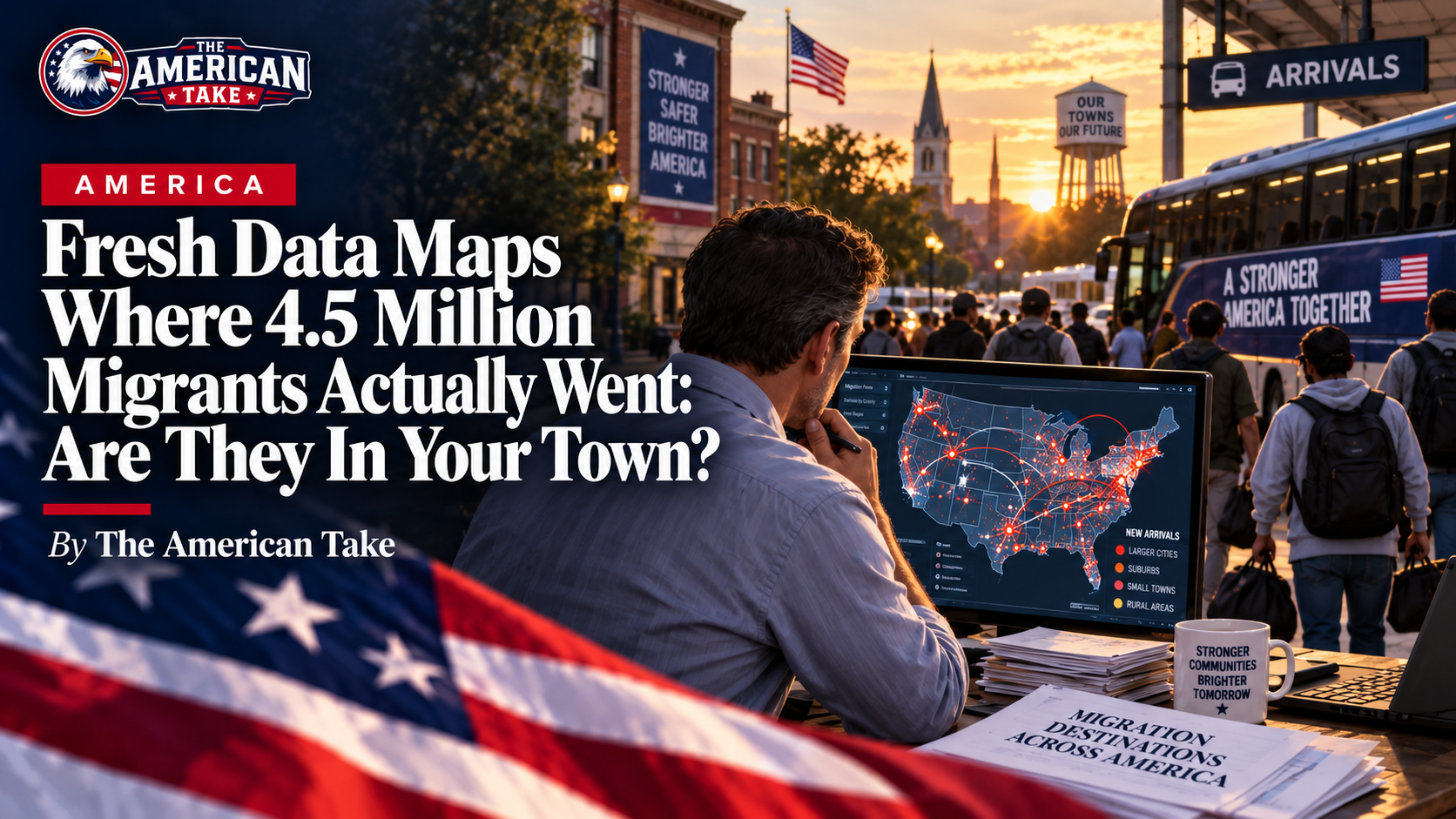
For years, Americans heard about the historic surge at the southern border in national numbers. New data now gives a much more local answer to the question many communities have asked: where did those migrants actually go?
An Associated Press analysis of federal data traces the initial destinations of roughly 4.5 million migrants who entered the United States during the extraordinary border surge between 2018 and 2025.
The answer is not simply New York, Miami, Los Angeles or the other places long associated with large immigrant populations.
The records show migrants dispersing into smaller cities and communities across the country, including places such as Elkhart, Indiana; Knoxville, Tennessee; Dodge City, Kansas; and communities around Cincinnati.
The data also shows how different this migration wave was from earlier ones.
Migrants arrived from more than 150 countries. Mexico remained important, but the surge also included large numbers of people from Venezuela, Ecuador, India, China, Ghana and numerous other countries. AP found that women and children made up nearly 60 percent of border releases, a sharp contrast with older migration patterns that were more heavily composed of single adult men.
Florida remained a major destination. But federal records also point to migration into cities and states that many Americans would not automatically associate with the recent border surge.
That is why the data matters politically and locally.
National debates about immigration often focus on Washington policy, detention statistics or encounters at the border. Once migrants are released into the United States, however, the practical consequences become local: housing, schools, jobs, transportation, health care, churches, charities and public services.
The AP reporting includes examples of communities that changed quickly.
Lockland, Ohio, a small community outside Cincinnati, received thousands of migrants, many from Mauritania. In Utah, Venezuelan migrants increasingly chose smaller cities rather than traditional destinations such as South Florida. Other groups followed family connections, job opportunities, housing costs or existing communities to destinations scattered across the country.
There is an important limitation to the data.
The federal records generally capture an initial destination provided during immigration processing. That does not necessarily mean every person remained at that address permanently. Migrants can and do move after entering the country.
So this is not a perfect real-time map of where every one of the 4.5 million people lives today.
It is still one of the clearest pictures yet of how the surge spread across the United States.
The data also complicates simplistic assumptions about what the migration wave looked like. Some migrants were seeking asylum. Some later received work authorization. Some settled into communities and found employment. Others remain in immigration proceedings or face possible removal.
Immigration enforcement has also varied significantly by location.
What the new analysis makes difficult to dispute is the geographic reach of the surge. The impact was not confined to a handful of border states or major sanctuary cities.
Millions of people moved from federal custody or processing into communities throughout the country.
For Americans who have watched the border debate as something happening hundreds or thousands of miles away, this dataset turns an abstract national argument into a local question:
Where did people go after they crossed the border—and was your community one of the destinations?
 A product of The American Take · Essential context. Deeper insight. A clearer view ahead.
DIRECT. SIMPLE. YOUR INBOX.
One email. No middleman.
No algorithm deciding whether you hear from us. No social platform standing between you and The American Take. Just The Personal Daily Brief, sent directly.