
Opinion · The American Take
Trump Furious With Supreme Court After Ruling on Mail In Voting
The Supreme Court left a lower-court injunction in place against a ballot-mail rule; Trump publicly criticized the justices after the decision.
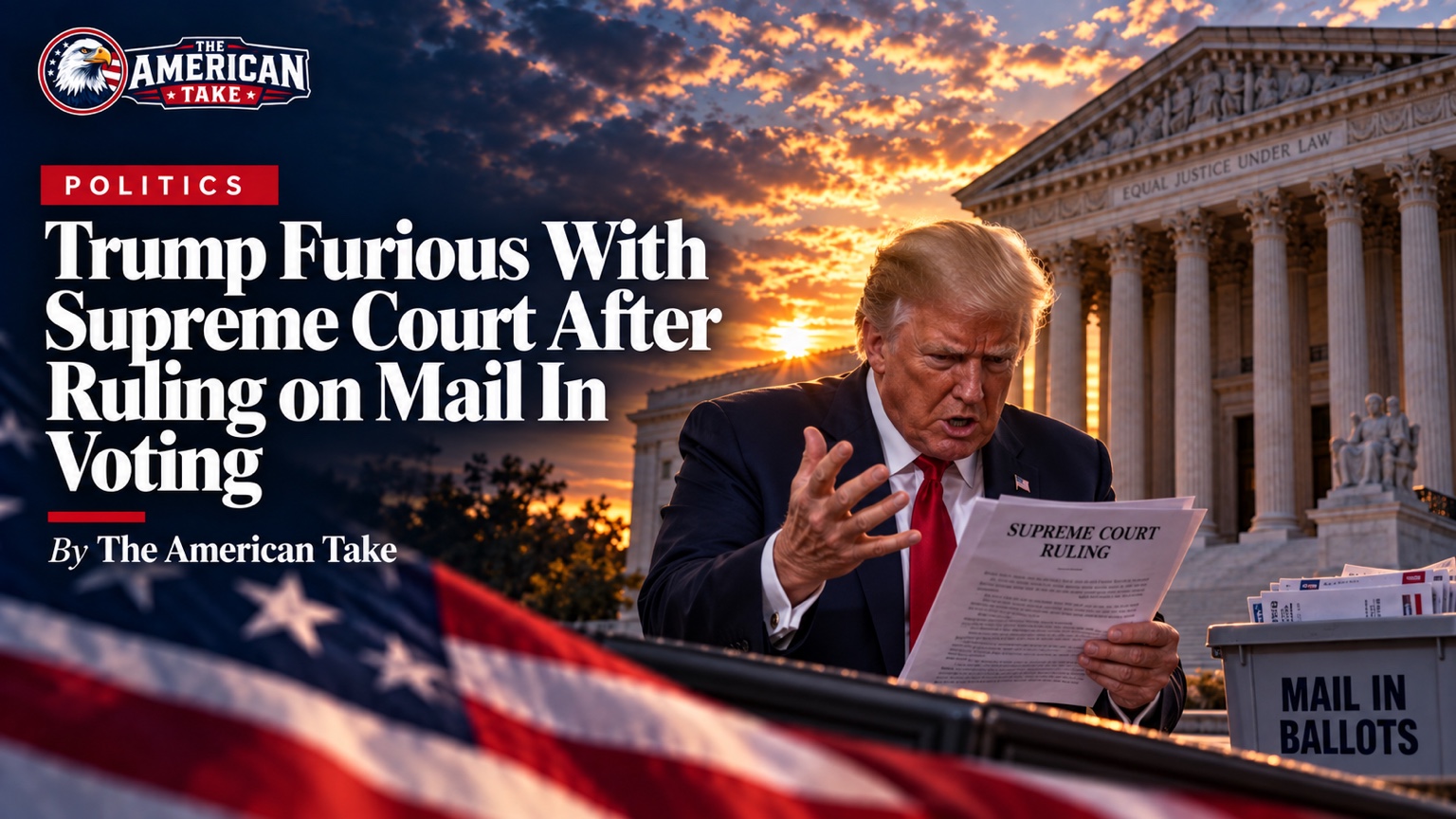
President Donald Trump sharply criticized the U.S. Supreme Court after it declined to let the U.S. Postal Service put a new ballot-mail rule into effect before the 2026 midterm elections. The order left a nationwide preliminary injunction in place. Trump’s anger was plain in his public remarks; the account below sticks to what he actually said on the record rather than guessing at his private state of mind.
Reuters reported that Trump lashed out at Supreme Court justices he appointed after the decision. In a social-media post, he wrote that the Court was “bullied and cajoled by the Radical Left” and said it had made decisions that set the country back. He also called the mail-voting ruling a “big loss” for Republicans. Those public statements are the factual basis for reporting that he reacted angrily to the ruling.
The case concerned a Postal Service rule issued after a presidential directive. The rule would have required federal ballot mail to use envelopes with specified features, including a designated election-mail logo, high-speed scanning capability, and a voter-specific barcode. States would also have had to submit voter information to a Postal Service portal. Mailings that did not comply could have been returned to the state for correction.
The Supreme Court denied the government’s request to pause the lower-court injunction. Justice Brett Kavanaugh wrote separately that, based on the record at that interim stage, he believed there was at least a fair prospect the Postal Service had statutory authority for the rule. But he concluded that applying it during the 2026 election cycle would be arbitrary and capricious because state and local election officials did not have enough time to implement it reasonably. Justices Samuel Alito and Clarence Thomas dissented.
The Court’s order did not establish a final answer to every legal question surrounding ballot-mail rules. It addressed the government’s effort to obtain emergency relief while the underlying litigation continued. That procedural distinction matters: the Court did not issue a final merits ruling declaring all possible federal ballot-mail requirements unlawful. It concluded that the government had not met the standard for a stay at that stage and that the equitable factors did not favor immediate implementation.
Trump has long criticized mail voting and argued for tighter rules. Election officials and voting-rights groups have challenged late changes to ballot procedures on the ground that they can disrupt printing, mailing, voter communication, and the handling of ballots already in process. The administration has said the proposed requirements would improve election security. The Court’s action means the rule cannot be enforced for the current election while the injunction remains in place.
The factual record therefore supports a straightforward account. The Supreme Court blocked the immediate implementation of a mail-ballot rule; Trump responded with unusually forceful public criticism of the Court and of justices he appointed; and the legal dispute continues. Readers can draw their own conclusion about the political significance of that response, but the quoted statements and the Court’s order provide the verifiable foundation for the story.
The reporting will be updated if the Court later resolves the merits or if the Postal Service changes the rule. Until then, the published account should remain anchored to the order and to Trump’s own public response.
 A product of The American Take · Essential context. Deeper insight. A clearer view ahead.
DIRECT. SIMPLE. YOUR INBOX.
One email. No middleman.
No algorithm deciding whether you hear from us. No social platform standing between you and The American Take. Just The Personal Daily Brief, sent directly.