
AMERICA · The American Take
Trump Won't Let Columbus Be Erased
President Trump's Columbus Day proclamation praises Christopher Columbus's "valor, adventure, and ingenuity" and points to a replica of the Baltimore Columbus statue that protesters pulled down in 2020, now standing beside the White House.
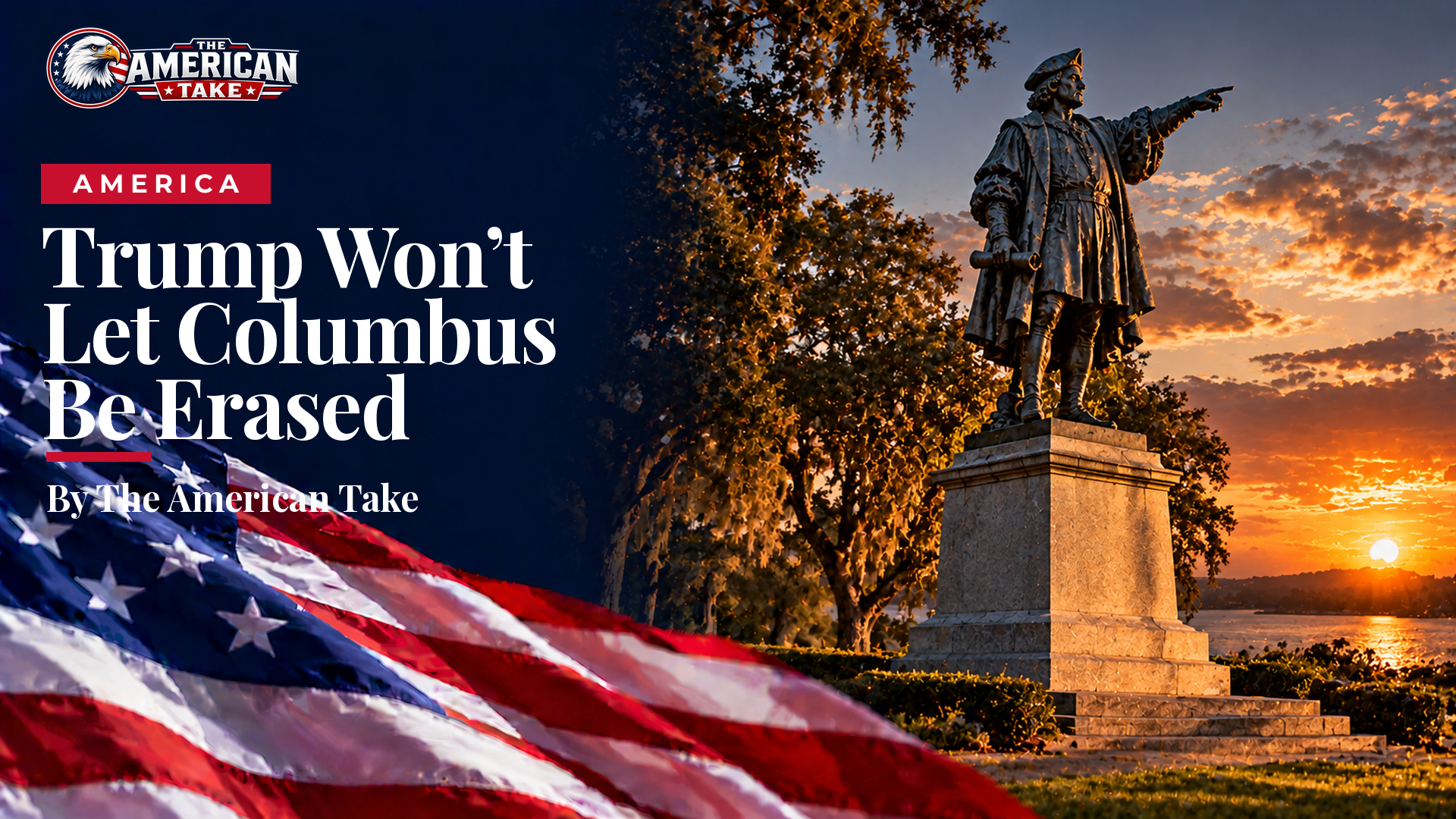
Some cities pulled Christopher Columbus off his pedestal. The White House put him back on one, and President Trump has made clear he is not going to let him be erased.
What the president did
President Trump signed Proclamation 11073 declaring Monday, Oct. 12, 2026, as Columbus Day. It praises Columbus's "valor, adventure, and ingenuity" and says his 1492 voyage "set in motion the forces that would culminate in the miracle of July 4, 1776."
The proclamation, published in the Federal Register, also points to an exact replica of the Columbus statue that stood in Baltimore for more than three decades until protesters pulled it down in 2020. The replica was installed on March 22 on the north side of the Eisenhower Executive Office Building, next to the White House, on loan from Italian American Organizations United. At a White House celebration on Oct. 9, Trump also announced that a 19th-century Italian marble statue of Columbus would be placed in the Rose Garden. The proclamation asks Americans to observe the day with ceremonies and directs that the flag be flown on public buildings. It rests on a 1934 joint resolution of Congress, modified in 1968, that asks the president to proclaim the second Monday of October as Columbus Day.
That makes two years running. Trump issued a similar proclamation in 2025, which omitted any mention of Indigenous Peoples' Day, the observance President Biden began recognizing by proclamation in 2021.
Where the states stand
Columbus Day remains a federal holiday under federal law. Indigenous Peoples' Day is not a federal holiday.
The states are divided. Newsweek, citing Pew Research Center data, reports that 30 states recognize Columbus Day in some form, but only 20 make it a paid holiday for state employees. Newsweek's map also counts 17 states plus Washington, D.C., that recognize Indigenous peoples on the second Monday in October, with five of them, Montana, Nebraska, Ohio, Pennsylvania and Rhode Island, doing so alongside Columbus Day as a paid holiday.
The argument plays out locally too. In Pueblo, Colorado, people gathered at the city's Columbus statue this week to say Indigenous people are still present, while supporters of the holiday rallied across the street.
Critics, including many Native American groups, say Columbus is a symbol of colonial oppression whose voyages opened the door to enslavement and violence against native peoples. Supporters, including the Sons of Italy, say the holiday is a vital recognition of Italian American history.
The take
Both things are true: Columbus was a man of his age, with real cruelty in his record, and his voyage was one of the great turning points in human history. A mature country can hold both facts. What it should not do is erase a holiday because a loud minority decided history must be judged entirely by the standards of 2026.
Columbus Day was never only about one explorer. For generations of Italian American families, many of whom faced real prejudice when they arrived, the holiday was a sign that they belonged here. In 1891, eleven Italian Americans were lynched by a mob in New Orleans. The following year, President Benjamin Harrison called for a national celebration of the 400th anniversary of Columbus's voyage. Tearing down Columbus is, for many of those families, tearing down something of their own story.
Honoring Native Americans is right, and nobody needs to cancel one people to honor another. Plenty of states have found room for both. The problem is the movement that wants Columbus gone entirely, the one that pulled statues down in 2020 rather than argue about them.
A statue beside the White House is a statement that the country will not let its history be decided by whoever is most willing to vandalize it. It is a good statement. Now the 20 states that still give Columbus Day its due should keep doing so, and the rest should ask why they stopped.
 A product of The American Take · Essential context. Deeper insight. A clearer view ahead.
DIRECT. SIMPLE. YOUR INBOX.
One email. No middleman.
No algorithm deciding whether you hear from us. No social platform standing between you and The American Take. Just The Personal Daily Brief, sent directly.