
WORLD & ENERGY · The American Take
Danes and Greenlanders Say New Deal Does Not Cede Sovereignty to U.S.
Denmark and Greenland say a planned security deal will strengthen the U.S. role in the Arctic without transferring sovereignty. The still-unpublished terms will decide whether that promise holds.
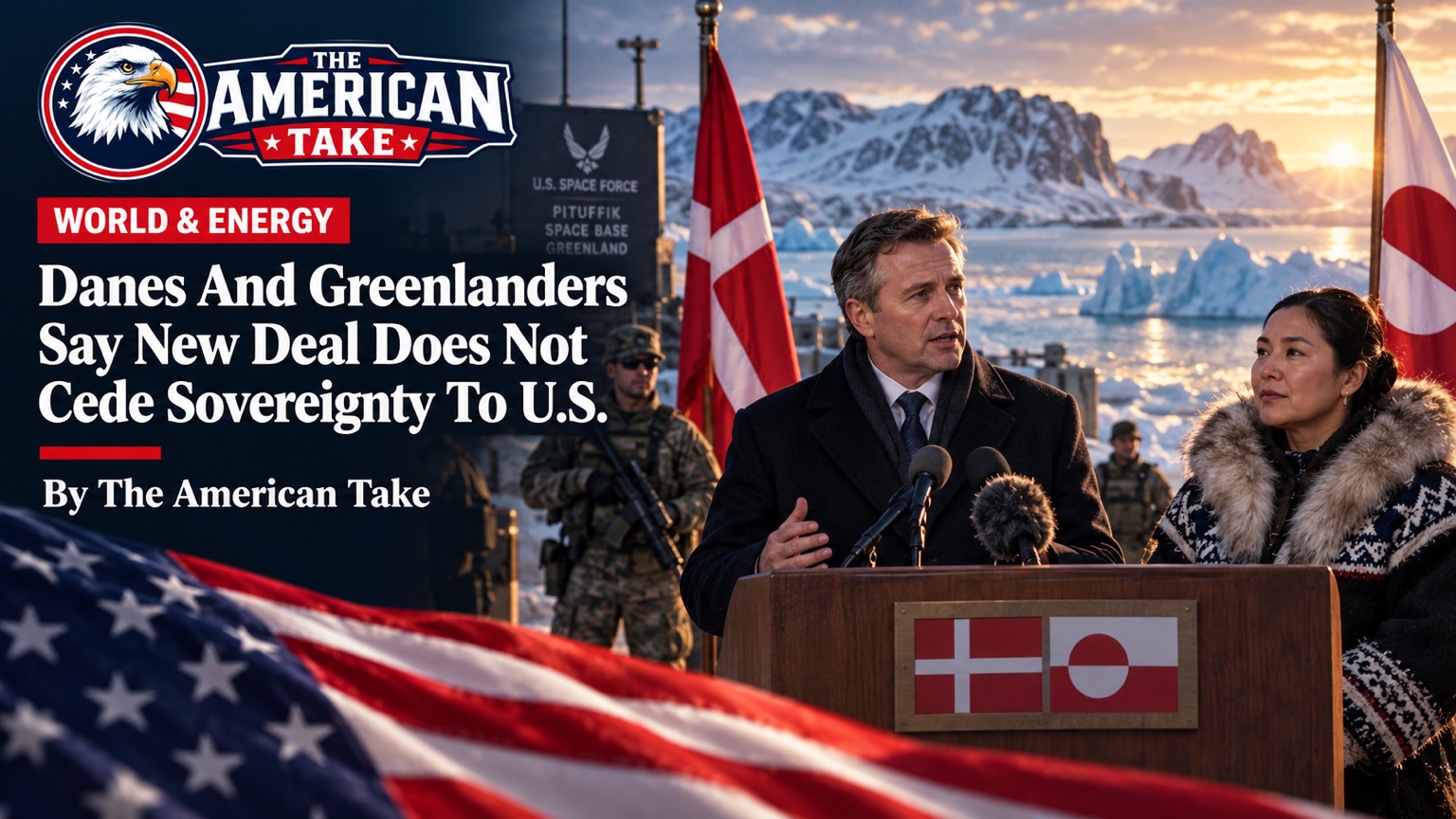
Denmark and Greenland say a planned security agreement with the United States will expand cooperation in the Arctic without giving Washington sovereignty over the self-governing island.
That assurance matters because President Donald Trump has described the emerging deal in much broader language, saying the United States would have permanent control over Greenland’s security and the ability to block adversaries from establishing bases, deploying forces or making sensitive investments there.
The agreement’s full text has not been published. It is expected to be signed during the United Nations General Assembly and would still be subject to the national parliamentary procedures required for it to take effect. Until the text is public and approved, claims about its exact military footprint, jurisdiction and investment powers remain provisional.
What Denmark and Greenland have said
In a joint announcement, Greenland, Denmark and the United States said they expected an agreement to strengthen security in the Arctic and North Atlantic.
Greenlandic Prime Minister Jens-Frederik Nielsen said the agreement recognizes Greenland’s interests and its role in international cooperation. Danish Prime Minister Mette Frederiksen said it recognizes the sovereignty and territorial integrity of the Kingdom of Denmark and the Greenlandic people’s right to self-determination.
Those are not minor phrases. Sovereignty concerns who holds ultimate legal authority. Territorial integrity rejects a transfer of the island itself. Self-determination recognizes that Greenlanders—not Washington—must decide Greenland’s political future.
Reuters reported that key details were still unavailable, including the scale of the American military expansion and whether any formal authority over foreign policy, security decisions or resources would shift to the United States. Danish Foreign Minister Lars Lokke Rasmussen said the deal should respect the kingdom’s “red lines.”
America already has a strategic foothold
The United States does not need to acquire Greenland to operate there. The 1951 defense agreement between Washington and Copenhagen already provides a legal foundation for the American presence, including what is now Pituffik Space Base.
Greenland’s position between North America and Europe makes it strategically important for missile warning, space surveillance and Arctic defense. Melting ice, new shipping possibilities and competition with Russia and China have only increased that importance.
An updated agreement could clarify access, construction, investment screening and the deployment of additional capabilities. It could also give Greenland economic and infrastructure benefits while strengthening NATO’s northern defenses.
But military access is not ownership. A host country can grant another nation extensive basing rights without transferring its territory. The unanswered question is how much independent decision-making the proposed deal preserves in practice.
Trump’s description of “permanent control” and Denmark’s insistence on undiminished sovereignty can coexist only if “control” means a durable, negotiated security role inside Danish and Greenlandic legal authority. If it means an American veto over broad areas of civilian policy or resources, the tension would be much harder to dismiss.
The American Take
The United States has a legitimate national-security interest in preventing hostile powers from establishing a military foothold in Greenland. Denmark and Greenland have an equally legitimate interest in preserving sovereignty and ensuring that Greenlanders benefit from decisions made about their land.
A strong deal should be able to satisfy both goals. It should define American military authorities precisely, preserve local jurisdiction outside those authorities, disclose the duration and termination terms, and make clear who controls sensitive investment decisions. Parliamentarians and the public should see those provisions before being told the sovereignty question is settled.
The preliminary political statements are encouraging, but they are not the agreement itself. Danes and Greenlanders say no sovereignty is being ceded. Trump says America is gaining permanent security control. The text, not the victory language from either side, will determine what the deal actually does.
 A product of The American Take · Essential context. Deeper insight. A clearer view ahead.
DIRECT. SIMPLE. YOUR INBOX.
One email. No middleman.
No algorithm deciding whether you hear from us. No social platform standing between you and The American Take. Just The Personal Daily Brief, sent directly.