
WORLD & ENERGY · The American Take
Iran War Escalates As Capital City Burns
A missile was intercepted over Riyadh, flames and smoke rose near the capital’s airport, and the Houthis claimed a broader attack—another dangerous expansion of the regional war.
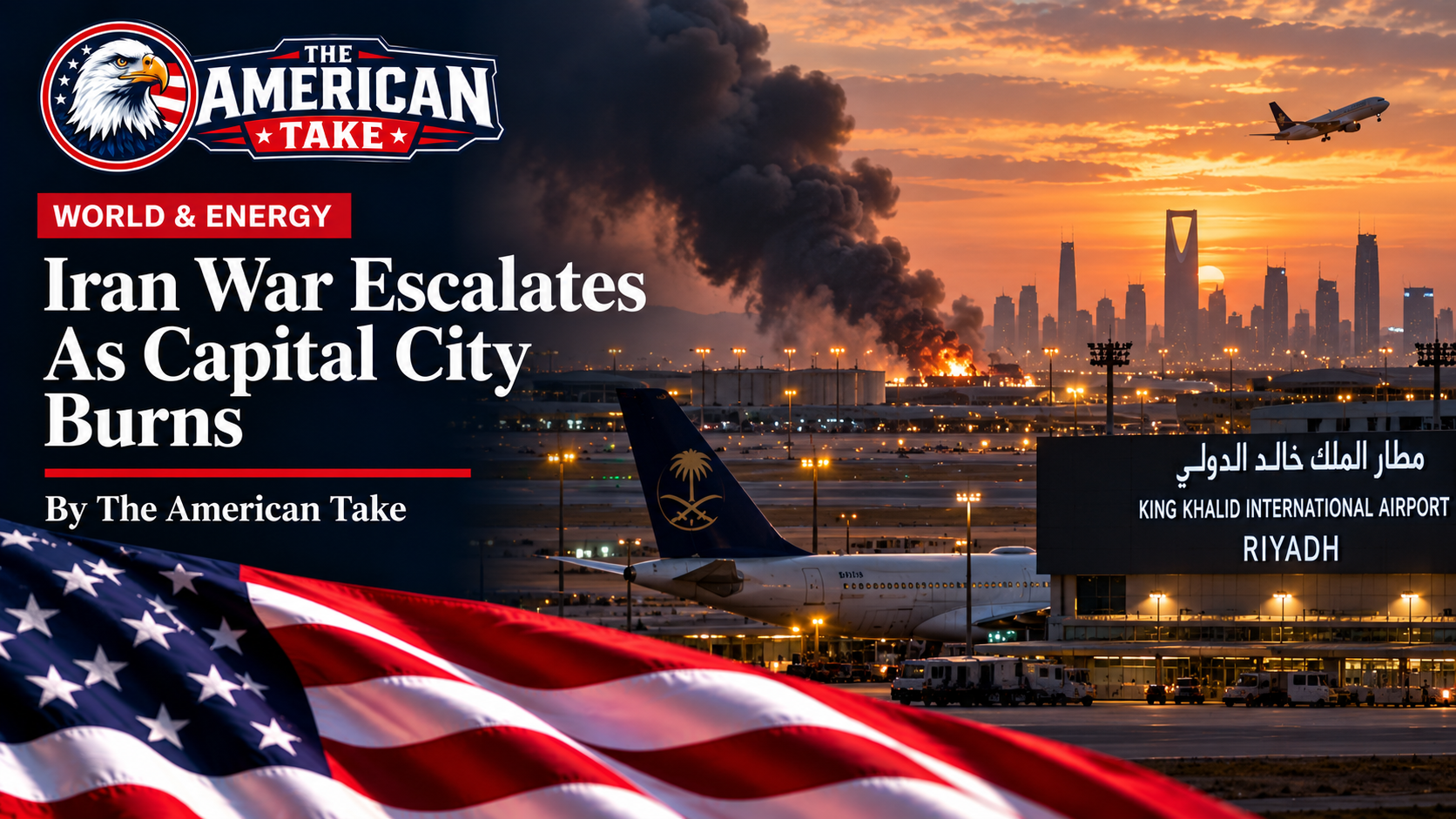
Flames and a towering column of black smoke rose near Riyadh’s main airport Saturday as Yemen’s Houthis claimed missile and drone attacks on the Saudi capital, opening another dangerous front in the regional conflict that grew out of the U.S.-Iran war.
The images were dramatic, but the limits of the evidence matter. Reuters footage showed fire behind what appeared to be fuel tanks near King Khalid International Airport. Saudi Arabia said its air defenses destroyed a missile fired toward Riyadh. Authorities did not publicly establish that the Houthis caused the airport-area fire, and there was no verified evidence that Riyadh as a whole was burning.
That distinction does not make the escalation minor. A national capital went under aerial warning, residents heard booms, defensive systems were activated and a fire burned beside a major international transportation hub. The Houthis said they had attacked “sensitive” sites in Riyadh with missiles and drones, but they did not identify the claimed targets.
What Saudi Arabia confirmed
Saudi Civil Defense sent overnight alerts warning of potential aerial danger in Riyadh and nearby Al-Kharj, then issued an all-clear Saturday morning. The Saudi-led military coalition said it intercepted a ballistic missile headed toward Riyadh and foiled other attacks aimed at Bish, Farasan, Taif and Yanbu.
Associated Press reported that Saudi authorities had not announced casualties or damage from the Riyadh missile attempt. The Houthis separately claimed attacks on infrastructure in other locations, including an Aramco facility in Yanbu, but those broader claims were not independently verified.
The safest factual conclusion is therefore narrower than the most alarming social-media descriptions: a missile was fired toward Riyadh and intercepted; fire and smoke were documented near the airport; the Houthis claimed a coordinated attack; and the precise connection between the claimed attack and the airport-area fire remained unclear in the initial reporting.
Why this is part of the Iran war
The Houthis are an Iran-backed armed movement that controls Yemen’s most populous areas and much of the country’s north. Their operations are their own claimed actions; public reporting did not establish that Tehran ordered Saturday’s attack.
Still, the Riyadh episode sits inside a conflict that widened after U.S. and Israeli strikes on Iran earlier in 2026. Reuters described the Saudi-Houthi fighting as a new theater in that larger war. Since July, Houthi forces have targeted Saudi cities, ships and energy infrastructure, while the continuing disruption around the Strait of Hormuz has increased the importance of alternative Red Sea export routes.
That is why a missile over Riyadh carries consequences far beyond one frightening night. Saudi Arabia is a major oil exporter. Riyadh is its political center, and the airport is a critical civilian and commercial gateway. Repeated attacks—or even repeated alerts and interceptions—can disrupt flights, raise insurance costs, unsettle energy markets and increase pressure for military retaliation.
Gulf markets fell Sunday after the attacks, although a single market session does not prove lasting economic damage. It does show how quickly security shocks are priced into a region central to global energy supplies.
The American Take
The alarming part is not a claim that every Houthi weapon hit its target. Saudi Arabia says the missile aimed at Riyadh was destroyed. The alarming part is that the expanding war has made an attempted strike on a capital city, smoke beside an international airport and warnings to civilians part of the region’s new reality.
There are also reasons to resist easy conclusions. Iran said it wanted the Saudi-Houthi fighting to end, and negotiations involving regional mediators continued. Those statements do not erase Iran’s long relationship with the Houthis, but neither do they prove direct Iranian command of this operation.
The United Nations Security Council condemned continuing Houthi attacks affecting civilian and energy infrastructure and also condemned the military escalation in Yemen. That is the right focus. Civilian airports, cities, shipping lanes and energy facilities should not become bargaining chips in a widening conflict.
Saturday’s fire did not prove that all of Riyadh was ablaze. It did prove that the war’s reach has expanded again—and that interception is not the same thing as security.
 A product of The American Take · Essential context. Deeper insight. A clearer view ahead.
DIRECT. SIMPLE. YOUR INBOX.
One email. No middleman.
No algorithm deciding whether you hear from us. No social platform standing between you and The American Take. Just The Personal Daily Brief, sent directly.