
WORLD & ENERGY · The American Take
North Korea Double Crosses Trump After U.S. Show of Goodwill
Trump scaled back joint military exercises to create room for diplomacy. North Korea answered the broader outreach with more missile launches and demands that Washington change course.
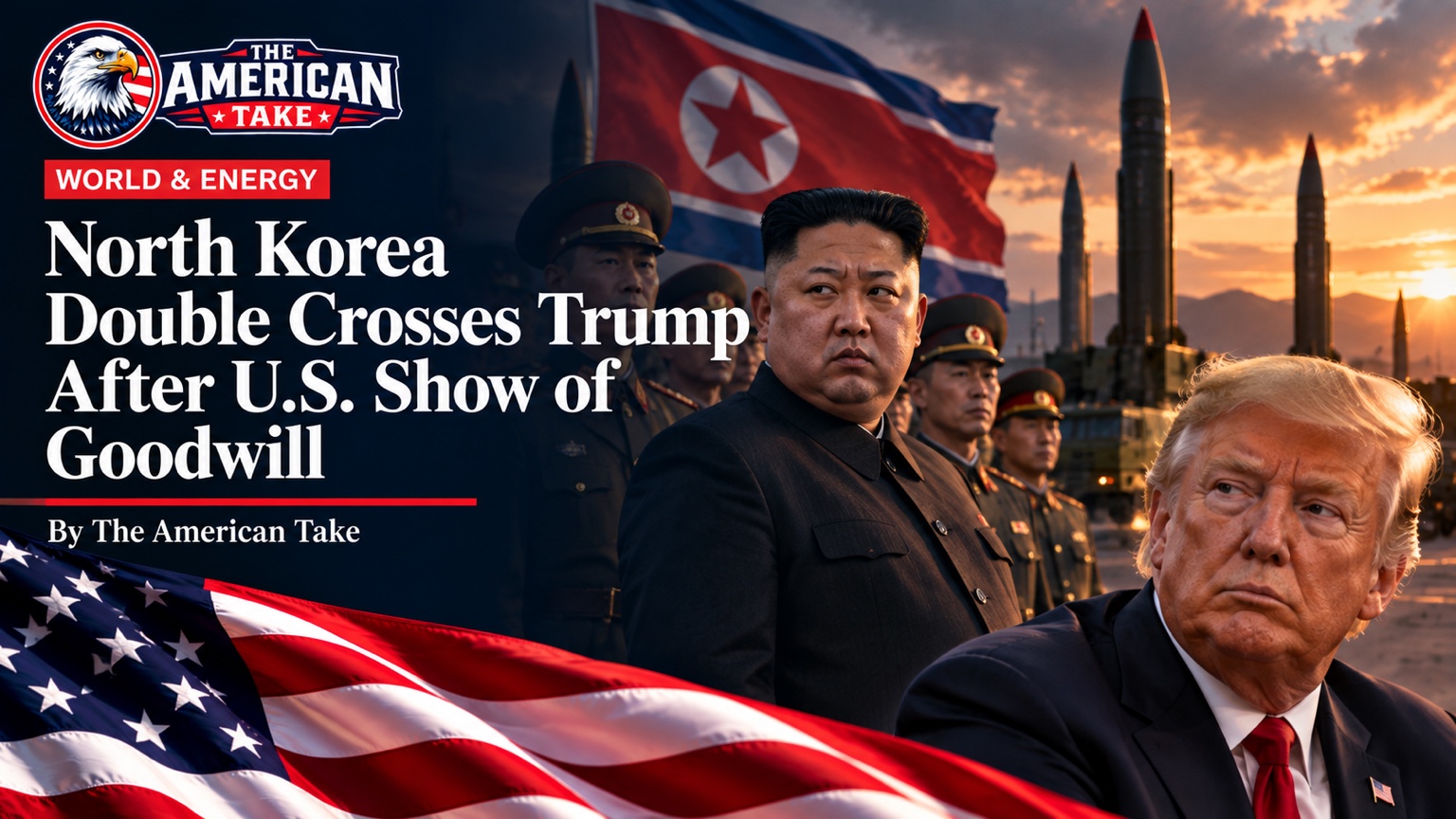
North Korea fired two suspected short-range ballistic missiles from its east coast Sunday, another military response after President Donald Trump scaled back U.S.-South Korea exercises in an effort to reopen diplomacy with Kim Jong Un.
The launches do not prove that Pyongyang broke a formal promise to Trump. North Korea never agreed to pause its weapons program in exchange for the reduced exercises. “Double crosses” describes the political result: Washington offered a confidence-building gesture, and Pyongyang answered the broader diplomatic opening with more missile activity and sharper nuclear rhetoric.
South Korea and Japan said the missiles were launched from the Wonsan area. The first traveled roughly 450 kilometers, or about 280 miles. A second missile launched about three hours later flew more than 600 kilometers, according to Reuters. Japan said both landed outside its exclusive economic zone, and no immediate damage was reported.
South Korea’s National Security Council condemned the launches as violations of United Nations Security Council resolutions and urged North Korea to stop. U.S. Indo-Pacific Command said the launches did not pose an immediate threat to American personnel, territory or allies, while adding that Washington was consulting closely with South Korea and Japan.
The goodwill that did not change Pyongyang’s course
In August, Trump ordered the Pentagon to substantially reduce a major round of joint exercises with South Korea. He cited the signal the drills sent to North Korea and his relationship with Kim, presenting the reduction as an attempt to create space for talks.
The United States did not abandon the alliance, and regional exercises continued in other forms. North Korea has focused on those remaining activities, including U.S.-led drills with South Korea and Japan, to argue that Washington’s “hostile policy” remains intact.
Kim Yo Jong, the North Korean leader’s sister and a senior regime voice, accused the United States and its allies of increasing tensions. North Korean officials have described the country’s nuclear status as irreversible and have said denuclearization cannot serve as the basis for renewed talks.
The latest launches were North Korea’s second missile test in a week. Days earlier, Pyongyang said a live-fire exercise involving missiles, artillery and drones demonstrated its destructive power. That sequence makes the political message difficult to miss: the regime is continuing to improve and display its arsenal while demanding that any future negotiation begin on terms far more favorable to North Korea.
A familiar negotiating pattern
North Korea has long paired weapons tests with diplomatic signaling. Missile launches demonstrate capability, create urgency and improve leverage. Talks can then be offered without surrendering the systems that generated the pressure in the first place.
Trump’s first-term diplomacy with Kim produced historic meetings but no lasting denuclearization agreement. Negotiations stalled in 2019 over sanctions relief and the scope of North Korea’s nuclear concessions. Since then, Pyongyang’s arsenal has grown, and its relationships with Russia and China have given it more room to resist American demands.
That background does not make diplomacy pointless. It does mean a unilateral reduction in exercises should be judged by what it produces. So far, the evidence is not a reciprocal North Korean drawdown. It is continued testing, an insistence on permanent nuclear status and pressure for Washington to change its policy first.
The American Take
Goodwill can be useful when it tests whether an adversary wants a way out. It becomes dangerous when leaders treat the gesture itself as an achievement regardless of the response.
The United States should keep channels open because miscalculation on the Korean Peninsula could be catastrophic. But talks must be built around verification and allied security, not faith in personal chemistry. South Korea and Japan live within range of North Korean weapons, and both have a direct stake in how exercises are reduced or restored.
North Korea did not secretly violate a signed bargain on Sunday. It did something more familiar: it banked the diplomatic gesture, kept its own military program moving and demanded additional concessions. That is the double cross voters should understand—not a broken handshake, but a one-way exchange.
 A product of The American Take · Essential context. Deeper insight. A clearer view ahead.
DIRECT. SIMPLE. YOUR INBOX.
One email. No middleman.
No algorithm deciding whether you hear from us. No social platform standing between you and The American Take. Just The Personal Daily Brief, sent directly.