
WORLD & ENERGY · The American Take
Putin Seizes Iconic Chocolate Company As Payback To West
Russia has placed Nestlé’s local business under temporary administration and linked the move to tensions with “unfriendly” Western states. The action gives a state-appointed manager operational control without yet transferring ownership.
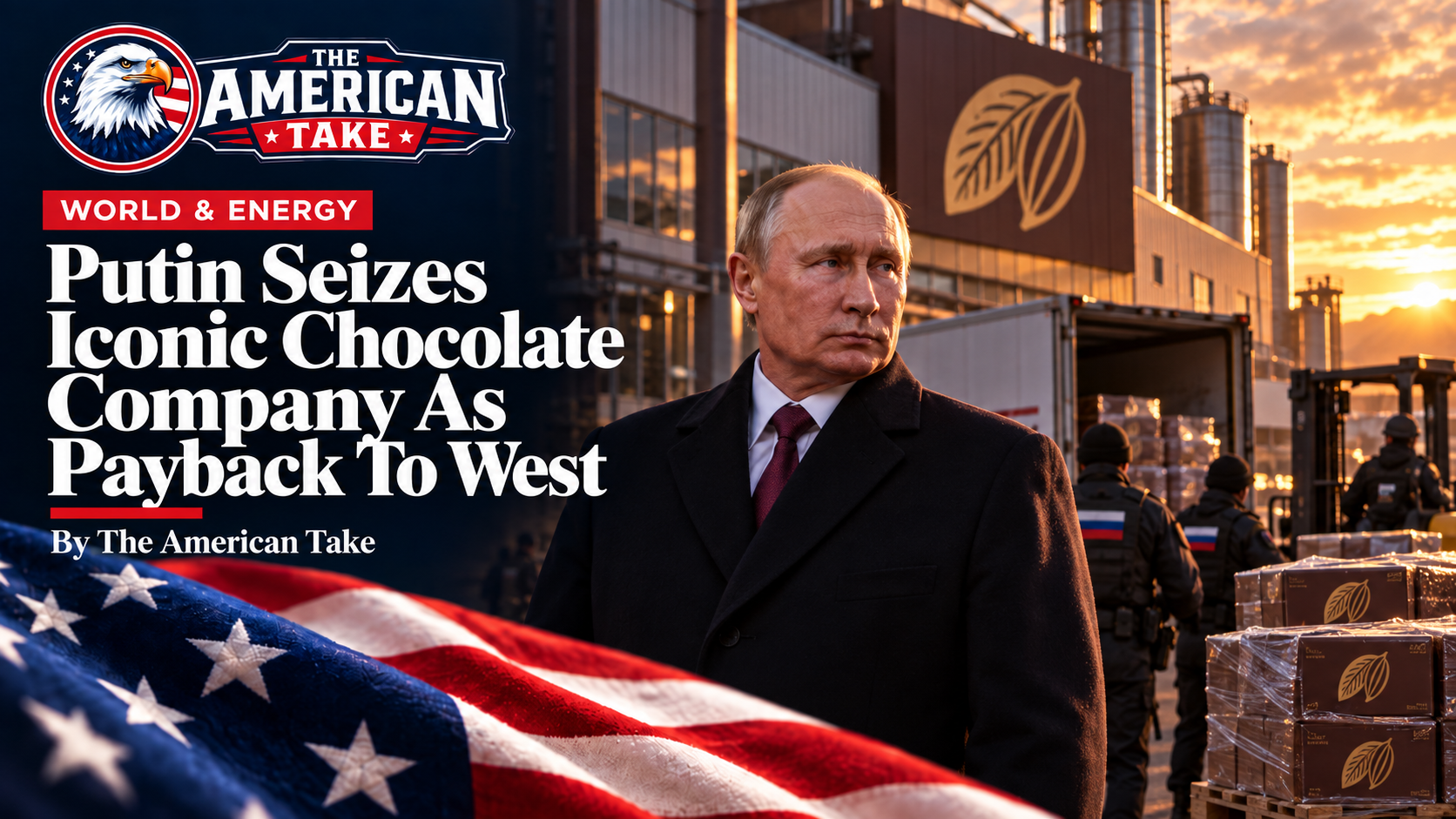
Russian President Vladimir Putin has placed Nestlé’s Russian operations under temporary administration, handing control of the business to a state-appointed manager as the Kremlin openly links its treatment of Western companies to the geopolitical confrontation over Ukraine.
The move is a seizure of operational control, not a confirmed permanent transfer of Nestlé’s ownership. Under Russia’s temporary-administration mechanism, the state-appointed manager assumes control of the assets while title does not formally change at that stage.
That legal distinction matters. It does not make the intervention minor. Previous temporary administrations involving Western companies have been followed by forced sales or transfers to Russian buyers, sometimes at substantial discounts and under rules favoring Kremlin-approved purchasers.
Kremlin spokesman Dmitry Peskov said hostile actions by “unfriendly” countries played a role in the decision involving Nestlé and French retailer Auchan. He pointed to European states’ involvement in military action against Russia. Switzerland does not supply weapons to Ukraine, but it has adopted many European Union sanctions, angering Moscow.
What Russia took control of
Nestlé has operated in Russia since the 1990s. Reuters reported that the company has six factories and about 7,000 employees there, producing goods including coffee, pet food and infant formula. KitKat, one of Nestlé’s best-known brands, gives the story its chocolate-company shorthand, but the affected operation is a broad food business rather than a single candy factory.
After Russia’s full-scale invasion of Ukraine in 2022, Nestlé suspended many brands and halted non-essential imports, exports, advertising and capital investment in Russia while continuing to sell some products it classified as essential foods. Analysts estimate Russia now represents roughly 1% of Nestlé’s global sales, down from about 2% before the war.
Putin’s decree named L.E.V. Management, a little-known Moscow company, as temporary administrator. Nestlé said it was assessing the situation and would take steps to protect its rights, business continuity and employees.
Temporary control can become permanent loss
Russia created the temporary-administration framework in 2023 for assets owned by companies from countries Moscow classifies as unfriendly. It has used the mechanism against businesses including Danone, Carlsberg and Fortum.
In multiple cases, temporary control was followed by sales to Russian buyers with Kremlin ties. Russia has separately imposed exit taxes, mandatory discounts and approval requirements on foreign companies trying to sell. Those precedents make permanent loss or a forced disposal a real risk for Nestlé, even though neither outcome had been formally completed when the decree was announced.
The Kremlin said only temporary administration was under consideration for now. Reporting also suggested Moscow may want Nestlé to reinvest in local operations or resume exports from Russian factories. Those possibilities are not mutually exclusive: state control can be used as leverage to change corporate behavior or force an exit on unfavorable terms.
The larger business risk
The intervention illustrates sovereign risk in an authoritarian or adversarial market. A company may hold legal title, employ thousands of people and comply with local rules, yet still lose operational control when political relations deteriorate.
Western sanctions are part of the context, and Moscow presents its actions as retaliation for economic and military pressure. Western governments, in turn, imposed sanctions after Russia invaded Ukraine. That sequence does not determine the legal rights of Nestlé shareholders, but it explains why commercial assets have become instruments in a state-to-state confrontation.
The most accurate reading is therefore narrower than “Russia bought Nestlé” and more serious than an ordinary management change. Nestlé still exists in Russia, its ownership has not been formally transferred, and its factories continue to matter to employees and consumers. But Putin’s decree removed operational control from the company and placed its assets in a system that has repeatedly preceded forced sales.
For multinational businesses, the episode demonstrates that contracts and brand recognition may offer limited protection when a host government can turn geopolitical conflict into control of private assets.
 A product of The American Take · Essential context. Deeper insight. A clearer view ahead.
DIRECT. SIMPLE. YOUR INBOX.
One email. No middleman.
No algorithm deciding whether you hear from us. No social platform standing between you and The American Take. Just The Personal Daily Brief, sent directly.