
ECONOMY · The American Take
Trump Makes Huge Move To Stop Foreigners From Taking American Jobs
President Donald Trump has extended for another year a major restriction on the H-1B visa program, continuing a policy designed by his administration to make it substantially more expensive for many employers to bring certain high-skilled foreign workers into the United States.
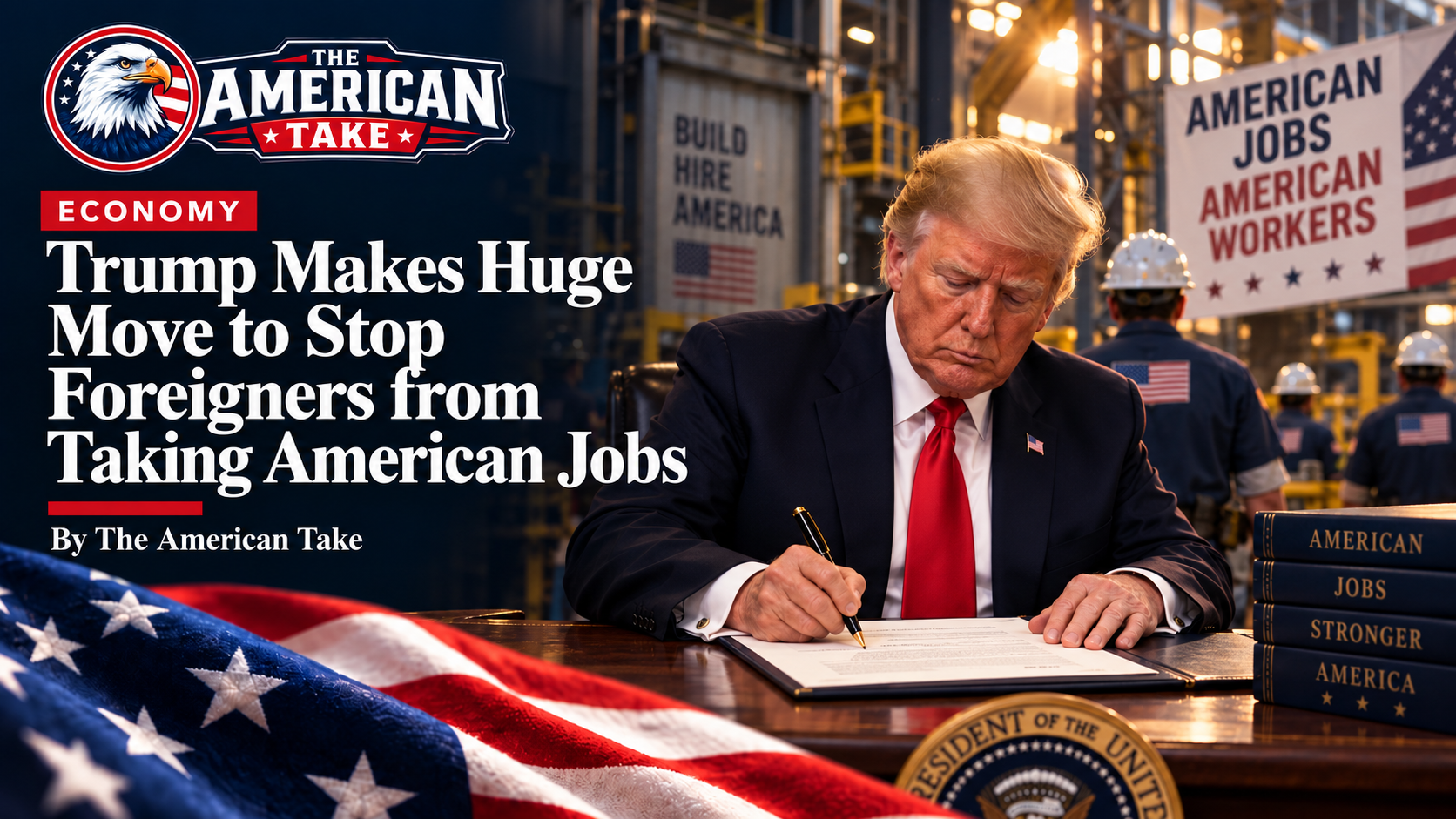
President Donald Trump has extended for another year a major restriction on the H-1B visa program, continuing a policy designed by his administration to make it substantially more expensive for many employers to bring certain high-skilled foreign workers into the United States.
A White House proclamation issued Sept. 18 extends the restrictions first imposed in 2025 through September 2027. Under the policy, certain H-1B petitions involving workers outside the United States generally must be accompanied by a $100,000 payment unless an exception applies.
The H-1B program allows U.S. employers to hire foreign workers for jobs classified as specialty occupations, including many positions in technology, engineering and other highly skilled fields. The Trump administration argues that some employers, staffing companies and outsourcing firms have used the program in ways that displace U.S. workers, suppress wages or fill positions with lower-cost labor rather than genuinely supplementing the domestic workforce.
The White House said the 2025 restrictions had produced measurable changes in H-1B filing patterns and argued that the conditions that prompted the original policy still exist. According to the new proclamation, the $100,000 payment has been made for more than 700 petitions since the restriction took effect.
The policy does not amount to a blanket prohibition on H-1B workers, and that distinction is important. The proclamation contains exceptions, including national-interest authority that can be exercised by the Department of Homeland Security. It also applies to defined categories of H-1B entry and petition activity rather than simply canceling the visa program.
The proclamation says the restriction applies to covered workers who enter or attempt to enter the United States after its effective date and who must seek admission to carry out approval of a covered petition. It directs employers filing for a worker outside the country to retain proof of the payment and directs the State and Homeland Security departments to coordinate enforcement. Reuters reported that the original policy did not apply to people already in the United States changing from student status or to renewals of existing H-1B visas.
The administration’s policy also remains tied up in court. A federal judge ruled earlier this year that the $100,000 fee was unlawful, concluding that it functioned as a tax Congress had not authorized. An appeals court later declined to pause that ruling while the administration continued its legal challenge. Separately, the administration has pursued rulemaking that could establish a fee of more than $100,000 through a different regulatory route.
Business groups and technology companies have pushed back on the restrictions. They argue that H-1B workers help fill genuine shortages in specialized fields and that steep fees could make it harder for American companies to recruit talent, compete globally and keep certain jobs in the United States.
The dispute is therefore about both executive authority and labor-market policy. Congress created the H-1B program in 1990, and challengers argue that the executive branch cannot impose what amounts to a major new charge without congressional authorization. The administration argues that entry restrictions and related program-integrity measures fall within presidential and agency authority. Until the appeals are resolved, employers face a policy that has been extended even as its legal foundation remains contested.
Supporters of the restrictions make the opposite case: if an employer genuinely needs a highly specialized worker from abroad, the company can justify the added cost, while employers that were using the program primarily to reduce labor expenses will have less incentive to do so.
That debate is now likely to continue for at least another year. Trump’s latest action does not end the H-1B program, but it extends one of the administration’s most aggressive attempts to reshape how the program is used and to prioritize U.S. workers in the high-skilled labor market.
The practical impact will depend heavily on the courts, the implementation rules and how employers respond. But the policy direction is unmistakable: the administration is making it harder and more expensive for companies to use H-1B visas in many circumstances while explicitly framing the change as protection for American workers.
 A product of The American Take · Essential context. Deeper insight. A clearer view ahead.
DIRECT. SIMPLE. YOUR INBOX.
One email. No middleman.
No algorithm deciding whether you hear from us. No social platform standing between you and The American Take. Just The Personal Daily Brief, sent directly.