
LAW & BORDER · The American Take
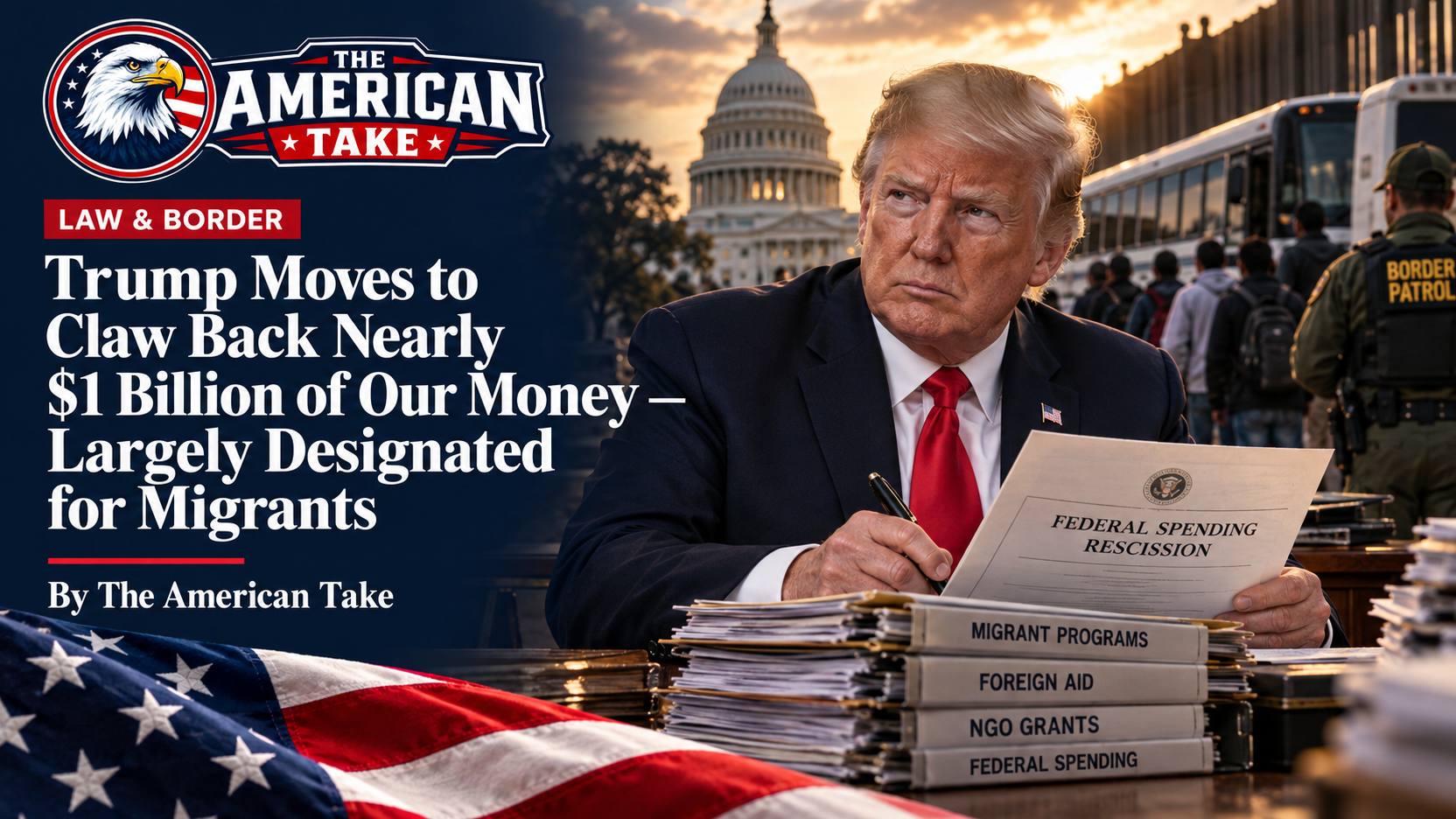
Trump Moves to Claw Back Nearly $1 Billion of Our Money — Largely Designated for Migrants
Washington has a habit of talking about government money as though it belongs to Washington.
Washington has a habit of talking about government money as though it belongs to Washington.
It doesn't.
It comes from taxpayers.
And President Donald Trump is now trying to claw back nearly $1 billion in federal spending that his administration says either no longer serves the country or never should have been funded in the first place.
The White House announced the new “pocket rescission” package on September 25, invoking authority under the Impoundment Control Act. The administration says the package targets nearly $1 billion in spending, including $567 million in HHS funding for services involving refugees, asylees and other noncitizens, another $15 million in DHS programs serving noncitizens, $10 million in other immigration-related grants and $25 million in migrant-student education funding. (whitehouse.gov)
That is why one word matters here: largely.
Not every dollar in the package was designated for migrants. The White House also identified money for DEI-oriented programs, international education, climate-related debt relief, housing-counseling grants, research programs and other spending it considers wasteful or ideologically driven. (whitehouse.gov)
But immigration-related spending is clearly the largest single component.
From an America-first conservative perspective, the administration's argument is easy to understand.
The federal government accumulated spending commitments during years when the southern border was under enormous pressure. If the circumstances have changed, if some programs are no longer necessary and if Congress appropriated more money than is now required, the administration argues taxpayers shouldn't be forced to watch the money get spent simply because bureaucracies know how to spend it.
That is the strongest case for what Trump is doing.
There is also a serious constitutional question on the other side.
Congress holds the power of the purse. Presidents do not normally have authority to erase spending simply because they dislike the purpose for which Congress appropriated it.
The administration is relying on a mechanism known as a pocket rescission. The White House says Trump successfully used the same long-dormant authority last year and is doing so again now. (whitehouse.gov)
Critics view that approach as an aggressive expansion of presidential control over spending Congress already approved.
That fight matters.
A libertarian-minded conservative can sympathize with Trump's desire to stop spending without pretending presidents should have unlimited authority over appropriations.
Government power does not become harmless merely because the person exercising it is pursuing a policy you happen to like.
Still, the spending itself deserves scrutiny on its own merits.
The White House says the largest rescission—$567 million—comes from HHS accounts used to support refugees, asylees and other noncitizens. It separately identifies grants for legal services, counseling, housing, transportation, childcare, education and other forms of assistance. Those descriptions are the administration's characterization of the programs, and supporters of the organizations involved would dispute some of the White House's political language surrounding them. (whitehouse.gov)
But the underlying budget question remains legitimate:
Why should American taxpayers fund every program simply because a previous Congress once put money into it?
That is where the administration's argument will resonate with many voters.
Federal spending has developed a peculiar one-way ratchet. Create a program and it tends to stay. Fund an organization and the funding becomes expected. Establish an emergency expenditure and eventually someone builds a permanent bureaucracy around it.
Cutting anything becomes politically traumatic.
That is not how a limited government is supposed to work.
At the same time, fiscal conservatism should be consistent.
Saving several hundred million dollars matters—but against a federal government that spends trillions, this package is not going to balance the budget. No administration should pretend otherwise.
If Washington is serious about fiscal discipline, entitlement growth, interest on the debt, defense spending, domestic discretionary spending and emergency appropriations all eventually have to face the same scrutiny.
But that doesn't make smaller cuts meaningless.
A government that cannot cancel unnecessary millions will never control unnecessary trillions.
Trump's latest rescission fight is therefore about more than immigration.
It is about a basic philosophical dispute over Washington:
Does appropriated money become the government's money simply because Congress once authorized it?
Or does every unspent dollar still belong, in a meaningful sense, to the people who earned it?
That is the argument now headed into another round between the White House, Congress and potentially the courts.
 A product of The American Take · Essential context. Deeper insight. A clearer view ahead.
DIRECT. SIMPLE. YOUR INBOX.
One email. No middleman.
No algorithm deciding whether you hear from us. No social platform standing between you and The American Take. Just The Personal Daily Brief, sent directly.