
Economy · The American Take
Everything Is About To Get Even More Expensive After Fed’s Latest Announcement
The Federal Reserve raised its benchmark rate by a quarter point, increasing borrowing costs as policymakers try to push still-elevated inflation back toward 2 percent.
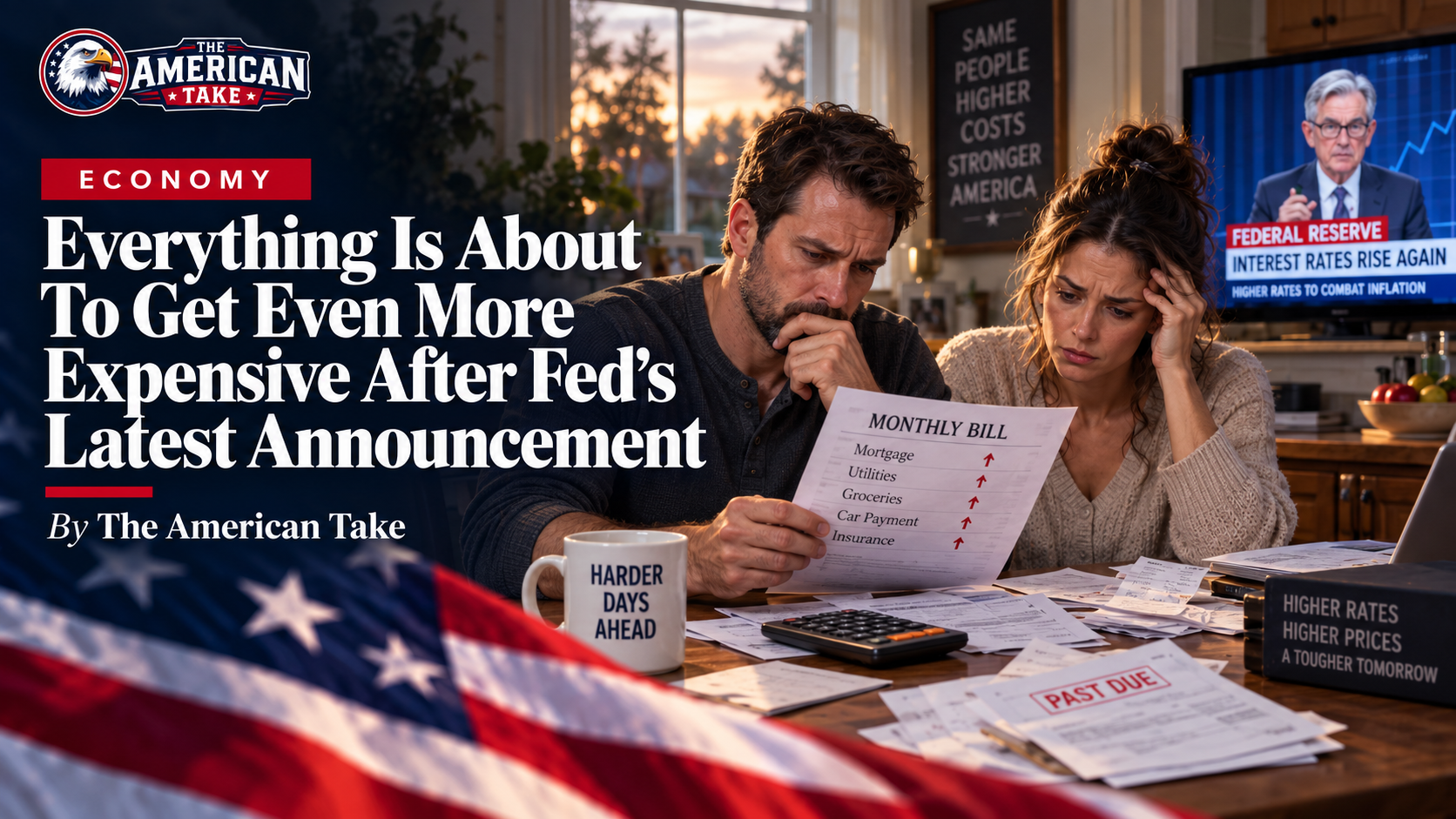
Americans already frustrated by the cost of borrowing just got another warning: the Federal Reserve has raised its benchmark interest rate for the first time in more than three years.
The Federal Open Market Committee voted unanimously Wednesday to raise the federal-funds target range by a quarter percentage point, to 3.75 percent to 4 percent. The Fed said inflation remains elevated and that the move is intended to bring price growth back toward its 2 percent target.
For households, the most immediate effect is not that every sticker price automatically jumps overnight. It is that borrowing money becomes more expensive across parts of the economy.
Credit-card rates, home-equity lines, some adjustable-rate loans, business borrowing and other forms of credit can respond to changes in short-term interest rates. Mortgage rates do not move one-for-one with the federal-funds rate, but they are influenced by the broader bond market and expectations for inflation and future Fed policy.
That means families already confronting high prices can also face higher financing costs.
The Fed’s reasoning is the other side of that story. Higher rates are designed to cool demand and slow inflation over time. In other words, the central bank is deliberately making credit more restrictive because policymakers believe inflation remains too high.
The Fed’s official statement said economic activity is still expanding at a solid pace. It described domestic spending as resilient, productivity growth as strong and capital investment as robust. It also said job gains have kept pace with the workforce and unemployment has changed little.
So this was not a declaration that the economy is collapsing.
It was, however, a declaration that the inflation problem is serious enough for policymakers to tighten financial conditions despite those signs of economic strength.
Markets noticed immediately. Major U.S. stock indexes fell after the decision, with investors reacting not only to the quarter-point increase but also to the possibility that additional rate hikes could follow. Reuters reported that 16 of 18 Fed policymakers expect at least one more increase before the end of the year.
For consumers, the practical question is where the squeeze shows up next.
A household carrying revolving credit-card balances may feel higher rates more quickly than a homeowner locked into a fixed-rate mortgage. A family shopping for a car or financing a major purchase could face a different monthly payment than it would have under lower rates. Small businesses that rely on credit lines can also see financing costs rise.
At the same time, savers can benefit from higher yields on some deposit accounts and short-term fixed-income products.
That is why the headline effect is complicated: higher rates can make borrowing more expensive now precisely because the Fed is trying to prevent inflation from remaining high later.
Fed Chair Kevin Warsh said the economy has strengthened but inflation remains the central problem. The committee’s statement was unusually direct: “Inflation remains elevated.”
For American families, the message is equally direct. The fight against inflation is not over, and the tool the Fed has chosen to use again is one that makes money itself more expensive to borrow.
Whether that eventually brings prices under control without materially weakening the economy will determine whether this move looks prudent in hindsight—or simply like another layer of pressure on households already watching every dollar.
 A product of The American Take · Essential context. Deeper insight. A clearer view ahead.
DIRECT. SIMPLE. YOUR INBOX.
One email. No middleman.
No algorithm deciding whether you hear from us. No social platform standing between you and The American Take. Just The Personal Daily Brief, sent directly.